Every winery runs on a spreadsheet
Walk into almost any cellar office and you will find one. It might be the morning Brix and temp log, the topping schedule, or the SO₂ additions for the week. Somewhere, someone has a spreadsheet open, and it is quietly doing a lot of work.
We just released Sheets in Blended, and this post is not a walkthrough of what it does. The product update covers that. What I want to talk about here is why we built it, because the reasoning says a lot about how we think winery software should work.
A spreadsheet is a notepad, not a record
Spreadsheets earned their place for a reason. They are fast. You can see thirty tanks at once, tab across a row, paste a column of numbers from the lab, and be done in a few minutes. Nobody needs training to use one.
But a spreadsheet does not really hold data. It holds text in boxes. Anyone can overwrite a cell, delete a row, or sort one column and not the others, and the file will not object. There is no history of who changed what, no link between the tank in cell B12 and the lot that is actually in it, and no guarantee that the volume you typed today agrees with the volume you typed last week.
That is fine for a notepad, and that is honestly what most cellar spreadsheets are. They capture the work in the moment. Then someone has to carry that work into the real record, whether that is the production system, the TTB reports, or the cost of goods. Every handoff is a chance for a number to get dropped, retyped wrong, or never make it over at all.
Not all cellar work looks the same
When we started mapping how wineries actually spend their day, a pattern showed up. The work falls into two very different shapes.
Some workflows are deep. A blend, a bond-to-bond transfer, a bottling run, or a press cycle with multiple fractions all carry real logic behind them. Volumes have to reconcile, tax classes have to follow the wine, costs have to roll forward, and the system needs to understand exactly what happened and why. That kind of work deserves a guided, detailed form, and a single entry might take a few minutes to get right.
Other workflows are wide. Logging morning Brix and temps across every fermenting tank. Recording a SO₂ addition on forty barrel groups. Topping the whole cellar. Tagging a set of lots for a program. None of these steps are complicated on their own, but they are repeated across many lots, tanks, and barrels, often every day during harvest. Pushing that kind of work through a detailed form one lot at a time is slow and frustrating, and it is exactly why people reach for a spreadsheet instead.
Most winery software treats every task like the first kind. The result is that the second kind ends up living in spreadsheets, outside the system, and the cycle of retyping starts again.
Finding the middle
So the question we kept asking was simple. What if you could keep the speed and feel of a spreadsheet, but every cell you typed into was already part of the real record?
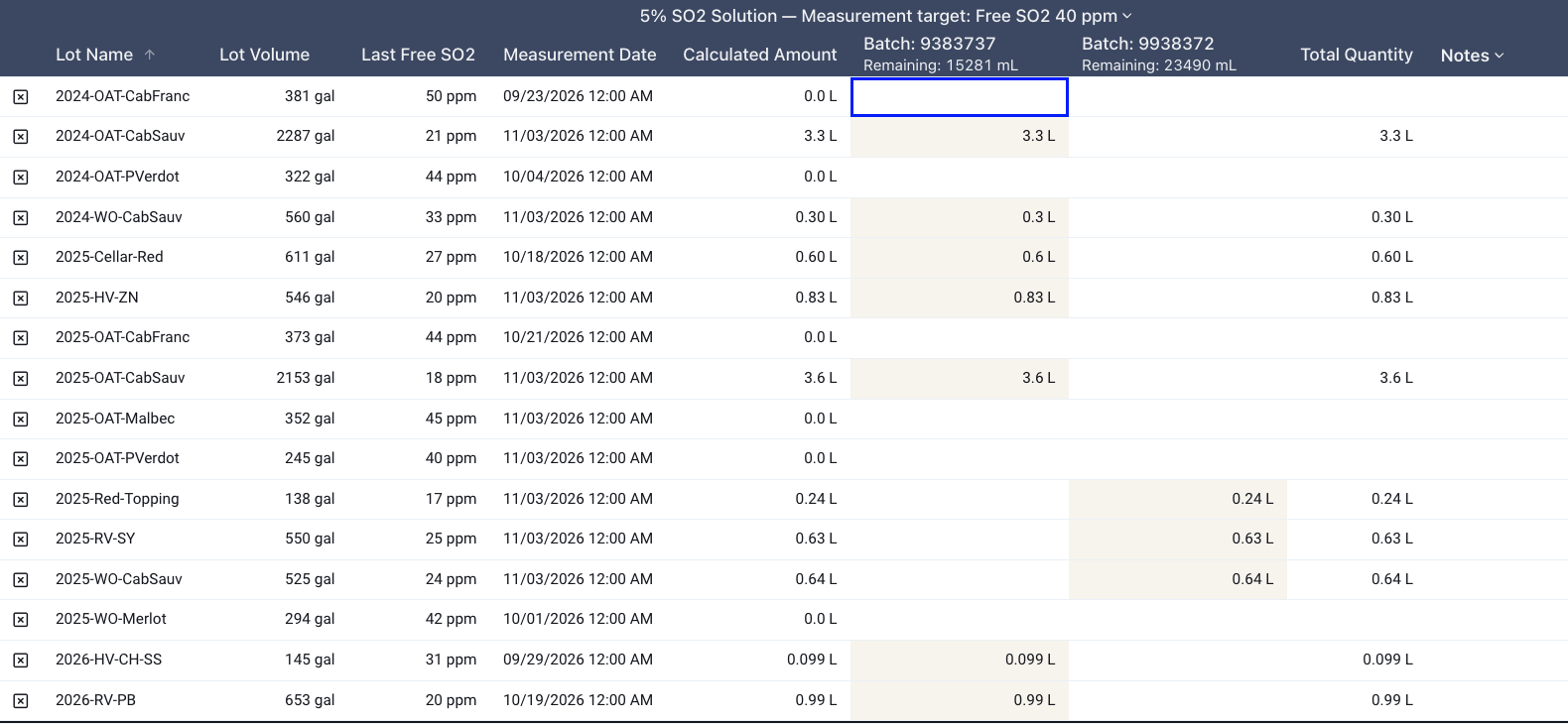
That is what Sheets is. It looks and works like a grid. You pick the lots, tanks, or barrel groups you are working on, they line up as rows, and you tab across entering measurements, additions, actions, tags, or topping. You can mix those types in a single sheet, so the whole morning round can happen in one place. If it is a routine you run every day, save it as a template and it is ready next time.
The difference is underneath. Every row is tied to an actual lot and vessel in Blended. Every value lands as a real, timestamped transaction. Nobody can quietly delete yesterday's numbers or sort a column out of alignment, because the grid is a way of entering data, not the place the data lives. When you are done, the record is updated, the history is there, and there is nothing left to carry over.
That structure is what makes the data worth entering. A Brix reading or an SO₂ addition entered in Sheets becomes part of that lot's history, shows up in your compliance reporting, and feeds your cost of goods. It sits next to everything else Blended knows about that wine, so the numbers tell one consistent story instead of living in a file nobody opens again after harvest.
Just as important is what Sheets does not replace. The deep workflows still get their detailed forms, because that is where the logic and validation belong. Work orders are still the place to plan and assign work. Sheets is for the wide work, and the goal is to let each kind of task use the tool that actually fits it.
Why it matters
The best data in a winery is the data that gets entered while the work is happening, by the person doing it. If the system makes that hard, the data ends up somewhere else, and it shows up late, incomplete, or not at all. Your compliance reports, your costing, and your ability to look back at a vintage all depend on what made it in.
Underneath all of this is a simple belief: software should bend to how the cellar works, not the other way around. We built Sheets because we do not think cellar teams should have to choose between fast and right. Sheets is live today in Production, and we will be bringing it to more areas of Blended soon. If you are already on Blended, give it a try on your next round of daily work and tell us what you think. If you are still running half your cellar out of spreadsheets, we would love to show you what it looks like when that work goes straight into the record.